
AC Load Bank Selection Guide: Key Indicators of Power Range, Accuracy Class, and Interface Compatibility
Time:2025-11-25
As a core tool for power system testing and power equipment verification, the scientific selection of AC load banks directly affects the accuracy of test results and engineering implementation efficiency. Among them, power range, accuracy class, and interface compatibility are the three key indicators that need to be focused on during selection.
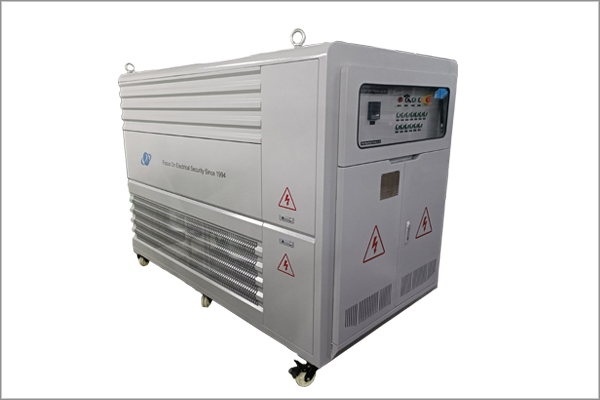
1000kW AC load bank
1000kW AC load bank
Matching the power range is the foundation of selection. It is necessary to determine the power coverage of the AC load bank based on the rated power of the test object, maximum load capacity, and test scenario requirements. For example, UPS testing in data centers requires high-power load banks that support continuous operation, while small and medium-power equipment can be used for small-scale power supply testing in laboratories. Meanwhile, a 10%-20% power redundancy should be reserved to avoid overload operation. In addition, modular load banks, with their advantage of flexible capacity expansion, are more suitable for scenarios with variable power demands.
Accuracy class directly determines the reliability of test data. During selection, attention should be paid to the measurement accuracy of parameters such as voltage, current, and frequency. Industrial-grade applications usually require an accuracy class of no less than Class 0.5, while high-precision testing scenarios (such as calibration of new energy power generation equipment) need products with Class 0.1 or higher. At the same time, load regulation accuracy should also be considered to ensure stability and accuracy during load switching.
Interface compatibility is crucial to ensuring system integration. It is necessary to confirm whether the control interfaces (such as RS485, Ethernet) of the AC load bank are compatible with the test system and monitoring platform, and verify that the specifications of the power interface match the output parameters of the test object. In addition, load banks that support remote control and data export functions are more suitable for the needs of intelligent testing scenarios, improving operational convenience.
In summary, the selection of AC load banks should be centered on test requirements, comprehensively balancing the three key indicators of power range, accuracy class, and interface compatibility. Only in this way can we select equipment that is suitable for the scenario and has reliable performance, providing strong support for power system testing and power equipment verification.
News Recommendation
-
 2026-08-21
TriumphLoad to Showcase Advanced Load Banks & Dummy Load Solutions at Middle East Energy 2026
-
 2026-05-28
TRIUMPH LOAD EXHIBITING AT ENERTEC ASIA 2026
-
 2024-09-11
TRIUMPH LOAD EXHIBITING AT Enlit Europe 2024 -BOOTH 7.H08
-
 2023-04-21
TRIUMPH LOAD EXHIBITING AT DATA CENTER WORLD GERMANY 2023-BOOTH F909
-
 2023-04-06
TRIUMPH LOAD EXHIBITING AT ELECTRIC POWER TECH KOREA 2023 – Booth G109
