
The Role of Rack Mounted Load Banks in Data Center Simulated Load Testing
Time:2026-03-06
In the era of rapid digital economic growth, data centers have become critical infrastructure supporting cloud computing, big data, artificial intelligence, and various online services. The stability of power supply systems, efficiency of cooling systems, and reliability of power distribution links directly determine whether a data center can operate safely, continuously, and efficiently. During key stages such as new construction acceptance, capacity expansion, and routine maintenance, the rack mounted load bank—a professional testing device that accurately simulates power consumption and heat generation of IT equipment—has become an indispensable tool for performing full-scenario, full-link simulated load testing.
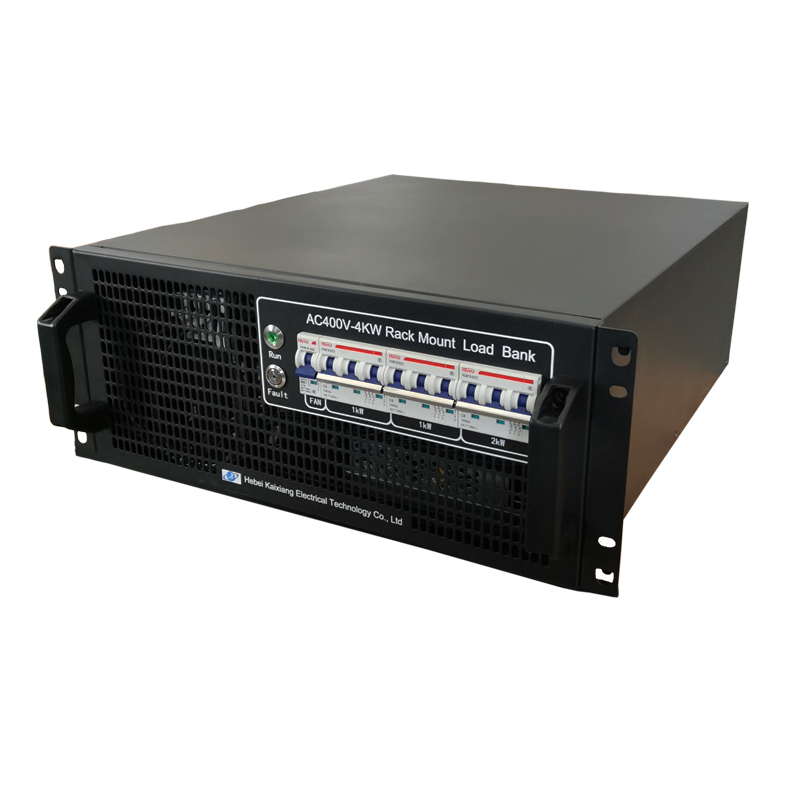
4kW rack mounted load bank
4kW rack mounted load bank
Adopting standard cabinet dimensions, rack mounted load banks can be directly installed in 19-inch standard racks. They feature a compact size and flexible deployment, highly replicating the electrical characteristics and thermal airflow patterns of servers, storage devices, switches, and other real equipment. Without loading actual services, they provide a quantifiable, repeatable, and controllable stress-testing environment for the entire infrastructure including power supply, cooling, power distribution, and monitoring, fundamentally avoiding interruption risks and financial losses caused by in-service testing.
1. Accurately Simulate Real Loads and Recreate On-Site Operating Conditions
Rack mounted load banks use resistive or resistive-inductive elements to form load units, with adjustable power in steps or continuously. They accurately simulate various operating states from light load, full load to peak overload, while reproducing server-level heat intensity and airflow organization.
Realistically reproduce cabinet-level heat source distribution and match the front-to-rear airflow path for realistic cooling system testing.
Provide stable and controllable electrical parameters with visible, traceable voltage, current, power, and power factor data to ensure accurate and reliable test results.
Replace real servers for extreme scenario tests including no-load, half-load, full-load, and sudden load change, without affecting online services or posing data security risks.
2. Full-Link Verification of Power Supply Systems to Strengthen Electrical Safety
The power supply system is the lifeline of a data center. Rack mounted load banks enable end-to-end verification of mains input, power distribution cabinets, busbars, UPS, backup generators, batteries, and other components.
Verify UPS loading capacity, switching response time, and battery backup duration to ensure uninterrupted power during outages.
Test diesel generator startup, grid connection, loading, stable operation, and protection logic to validate backup performance under extreme conditions.
Detect voltage drop, connection temperature rise, harmonics, and three-phase balance under high load to reveal potential issues such as loose connections, aging, and insufficient capacity.
Validate the reliability of overload protection, short-circuit protection, and leakage protection mechanisms.
3. Scientifically Evaluate Cooling Performance and Optimize Energy Consumption
Cooling systems directly affect data center PUE and equipment lifespan. Rack mounted load banks enable cooling capacity calibration and optimization without real IT loads.
Simulate high-density cabinet heat sources to verify cooling performance of precision air conditioners, cold aisle containment, in-row coolers, and liquid cooling systems.
Identify local hotspots, airflow short-circuits, and cold energy waste to support airflow optimization.
Support full-load cooling tests to verify that temperature and humidity meet standards under high-temperature and full-configuration limits.
4. Full Lifecycle Coverage for Acceptance and Operation & Maintenance
Rack mounted load banks serve the entire data center lifecycle: construction acceptance → routine O&M → expansion → decommissioning.
New deployment: complete integrated system testing (IST) to validate design and actual performance as acceptance evidence.
Periodic maintenance: perform preventive tests on UPS, generators, and power distribution systems to eliminate hidden faults.
Expansion: verify that new cabinets, circuits, and cooling units operate stably with legacy systems.
Energy optimization: measure power consumption at different load rates to find optimal operating points and reduce PUE.
5. Adapt to High-Density and Liquid-Cooling Trends for Next-Generation Data Centers
With rising power density driven by AI and high-performance computing, traditional load banks fall short. Modern rack mounted load banks are upgraded toward high power, modularity, intelligence, and liquid cooling compatibility.
Support air/liquid cooling modes to accurately simulate power and thermal characteristics of liquid-cooled servers.
Reach tens of kilowatts per rack to meet testing demands for AI clusters and HPC scenarios.
Enable remote centralized control, automatic data recording, and report generation for intelligent and lights-out operations.
Conclusion
The rack mounted load bank is far more than a “dummy load.” It serves as a verification platform, diagnostic tool, and safety barrier for data center infrastructure. It controls risks before service launch and eliminates hidden troubles before failures occur, strongly supporting power reliability, cooling efficiency, and operational safety. As data centers evolve toward higher density, higher energy efficiency, and higher reliability, rack mounted load banks will continue to play an irreplaceable role.
News Recommendation
-
 2026-08-21
TriumphLoad to Showcase Advanced Load Banks & Dummy Load Solutions at Middle East Energy 2026
-
 2026-05-28
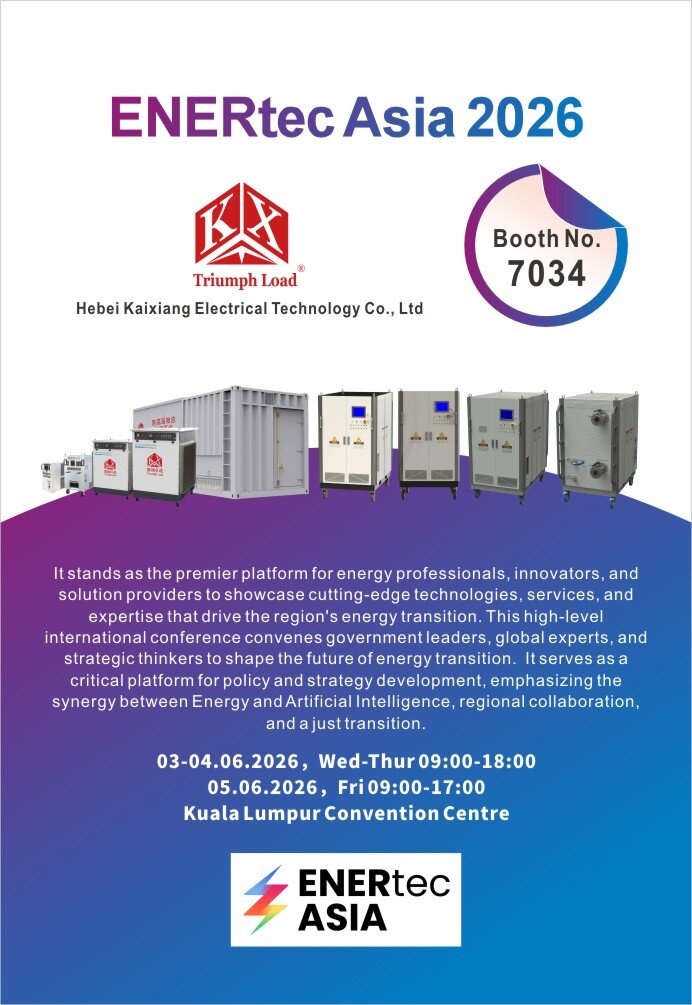
TRIUMPH LOAD EXHIBITING AT ENERTEC ASIA 2026
-
 2024-09-11
TRIUMPH LOAD EXHIBITING AT Enlit Europe 2024 -BOOTH 7.H08
-
 2023-04-21
TRIUMPH LOAD EXHIBITING AT DATA CENTER WORLD GERMANY 2023-BOOTH F909
-
 2023-04-06
TRIUMPH LOAD EXHIBITING AT ELECTRIC POWER TECH KOREA 2023 – Booth G109
