
Application of Liquid-Cooled Load Banks in AI Data Centers
Time:2026-06-04
With the rapid expansion of large-model training and intelligent inference industries, the power density of a single cabinet in AI data centers has surged from the traditional 5kW to over 100kW. After the launch of high-end computing chips such as GB200, high-density heat dissipation and power supply stability have become core challenges in computer room construction. Thanks to its high heat-flux simulation capacity, the liquid-cooled load bank has evolved into essential equipment for acceptance inspection and daily maintenance of AI computing hubs. Adopting deionized water or ethylene glycol coolant as heat exchange medium and a closed-loop water cooling circuit to dissipate internal heat, liquid-cooled load banks deliver dozens of times higher heat transfer efficiency than air-cooled counterparts, compatible with two mainstream liquid cooling solutions: cold-plate cooling and immersion cooling.
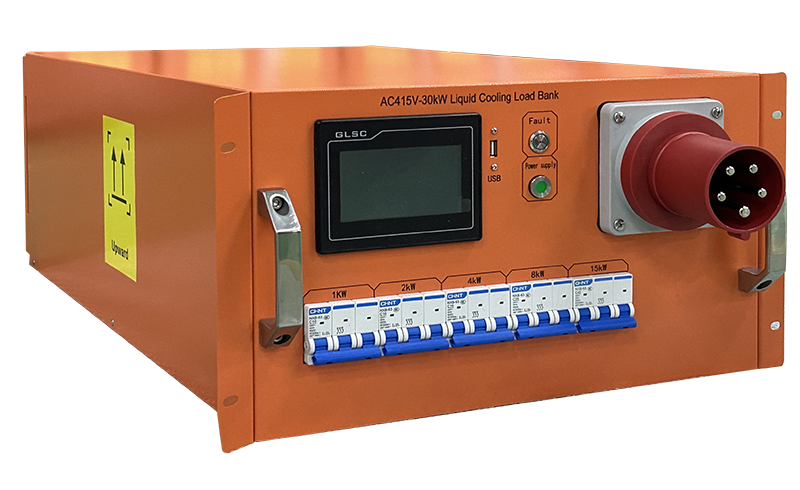
Liquid-Cooled Load Bank
Liquid-Cooled Load Bank
During acceptance for newly-built data centers, liquid-cooled load banks serve as core testing instruments for infrastructure verification. Featuring stepless adjustable power output, they accurately replicate heat generation under idle, full-load and abrupt power fluctuation conditions of AI servers, simulating instantaneous GPU power swings during large-model training. Engineers test the load limits of CDU heat exchangers, cooling pipelines and power distribution buses to eliminate hidden risks like uneven pipeline pressure, local hotspots and power overload, preventing thermal throttling or unexpected shutdown after official server deployment. Modular rack-mounted design allows parallel expansion from 20kW to 120kW per unit to fit diverse cabinet specifications and shorten project acceptance cycles.
For routine maintenance, these load banks conduct periodic full-load tests on backup generators and UPS systems to guarantee seamless power switchover amid blackouts. Operators regularly recheck liquid cooling efficiency via load testing and adjust chiller parameters based on water temperature and flow data to reduce PUE and promote energy conservation.
Low noise, compact dimension and superior high-temperature resistance make liquid-cooled load banks ideal for compact high-density computing layout. As liquid cooling dominates the AI infrastructure sector, such devices will keep upgrading toward precise dynamic simulation and intelligent remote control to secure reliable, efficient and eco-friendly operation of next-generation AI data centers.
News Recommendation
-
 2026-08-21
TriumphLoad to Showcase Advanced Load Banks & Dummy Load Solutions at Middle East Energy 2026
-
 2026-05-28
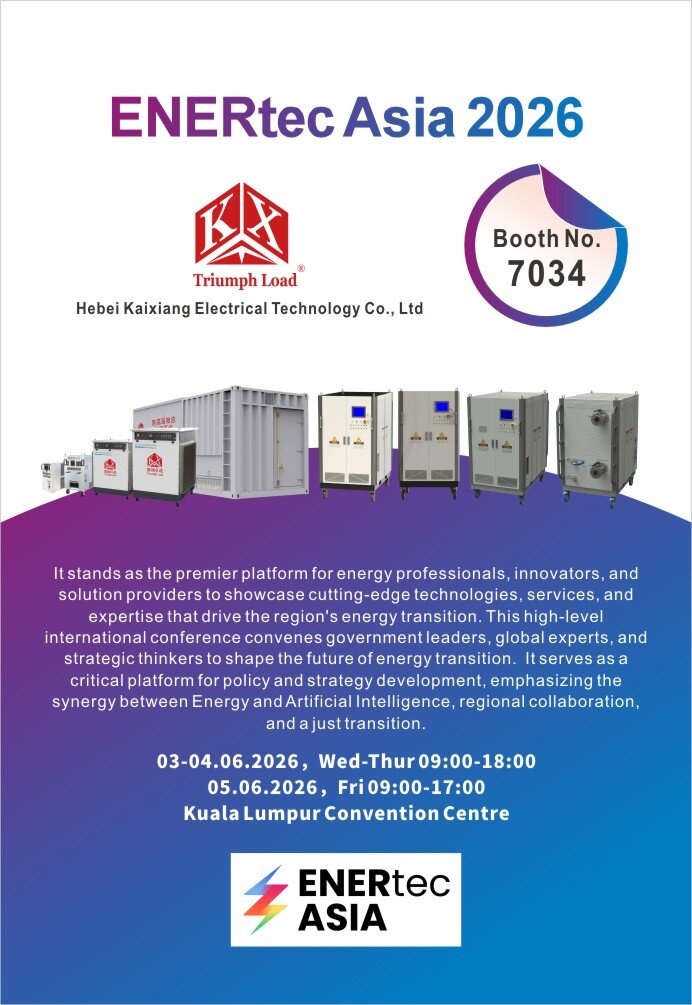
TRIUMPH LOAD EXHIBITING AT ENERTEC ASIA 2026
-
 2024-09-11
TRIUMPH LOAD EXHIBITING AT Enlit Europe 2024 -BOOTH 7.H08
-
 2023-04-21
TRIUMPH LOAD EXHIBITING AT DATA CENTER WORLD GERMANY 2023-BOOTH F909
-
 2023-04-06
TRIUMPH LOAD EXHIBITING AT ELECTRIC POWER TECH KOREA 2023 – Booth G109
