
What Are the Types and Characteristics of Cooling Media for Liquid-Cooled Load Banks?
Time:2026-01-12
A liquid-cooled load bank is a device that transfers and dissipates electrical energy through liquid media, widely used in load testing and maintenance scenarios for power supply equipment such as generators and UPS systems. The selection of cooling medium directly affects the heat dissipation efficiency, operational stability and applicable working conditions of the liquid-cooled load bank. Common cooling media for liquid-cooled load banks are mainly divided into three categories: water-based media, oil-based media and specialized coolants, each with the following characteristics.
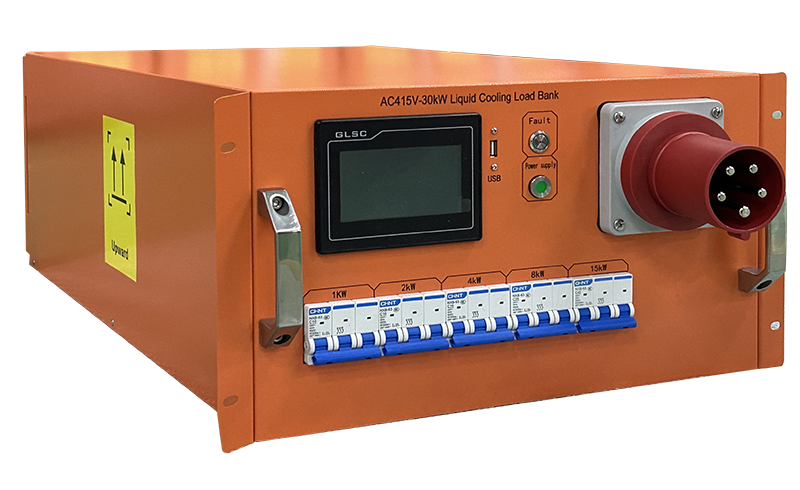
30kW liquid-cooled load bank
30kW liquid-cooled load bank
Water-based media are the most widely used type in liquid-cooled load banks, with deionized water and softened water as the core components. The advantages of this type of medium include high specific heat capacity, high thermal conductivity, heat dissipation efficiency far exceeding air cooling, wide availability, low cost and environmental friendliness. However, water-based media have obvious shortcomings: their freezing point is 0℃, and they are prone to freezing and expansion in low-temperature environments, which may damage equipment pipelines; meanwhile, ordinary water has certain electrical conductivity, and leakage may cause electrical short circuits. Therefore, it is necessary to add anti-corrosion, anti-freezing and anti-static additives to adapt to precision power supply testing scenarios.
Oil-based media mostly use insulating oils such as mineral oil and synthetic oil, and their core advantage is excellent insulation performance. Even if medium leakage occurs, it will not affect the electrical safety of the equipment, making them suitable for load testing of high-voltage and high-power power supplies. Oil-based media have a high boiling point, can operate stably in high-temperature environments, and have moderate viscosity with extremely low corrosiveness to pipelines. However, oil-based media have lower specific heat capacity and heat dissipation efficiency than water-based media, and the cost of oil products is relatively high. Long-term use is prone to oxidative deterioration, requiring regular testing and replacement.
Specialized coolants are composite media developed for the working conditions of liquid-cooled load banks, usually formulated with base fluids, antifreeze agents, rust inhibitors, anti-foaming agents and other components. This type of medium combines high heat dissipation efficiency with good insulation and anti-freezing properties, can operate stably in a wide temperature range from -40℃ to 100℃, and has stable chemical properties, not prone to scaling and corrosive products, with a long service life. Specialized coolants have strong adaptability and can meet the needs of liquid-cooled load banks with different power levels and working conditions. However, compared with water-based and oil-based media, their R&D and procurement costs are higher, making them more suitable for high-end testing scenarios with strict reliability requirements.
In summary, the selection of liquid-cooled load bank media should be based on actual application scenarios: water-based media are suitable for normal temperature, medium-low voltage and low-cost testing needs; oil-based media are suitable for working conditions with high voltage and high insulation requirements; specialized coolants are more suitable for high-end testing scenarios with wide temperature range and high reliability. Reasonable selection of medium type is the key premise to ensure the efficient and safe operation of liquid-cooled load banks.
News Recommendation
-
 2026-08-21
TriumphLoad to Showcase Advanced Load Banks & Dummy Load Solutions at Middle East Energy 2026
-
 2026-05-28
TRIUMPH LOAD EXHIBITING AT ENERTEC ASIA 2026
-
 2024-09-11
TRIUMPH LOAD EXHIBITING AT Enlit Europe 2024 -BOOTH 7.H08
-
 2023-04-21
TRIUMPH LOAD EXHIBITING AT DATA CENTER WORLD GERMANY 2023-BOOTH F909
-
 2023-04-06
TRIUMPH LOAD EXHIBITING AT ELECTRIC POWER TECH KOREA 2023 – Booth G109
